

Everything is Alive is delightfully empathetic
I love this podcast so much! Particularly the latest episode where Ian Chillag interviews Emmy (played by Emmy Blotnick), who is a pregnancy test and who is also delightful, upbeat, and is excited (and maybe a little apprehensive) to get peed on.

I love this podcast so much! Particularly the latest episode where Ian Chillag interviews Emmy (played by Emmy Blotnick), who is a pregnancy test and who is also delightful, upbeat, and is excited (and maybe a little apprehensive) to get peed on.
Part of why I love Everything is Alive so much is the way it radically shifts my perception/perspective and how it creates a sense of empathy for things we don’t usually have empathy for. It uses anthropomorphism to give inanimate objects voices and allows me to connect with them. This shifts my whole perspective on the world and the people and objects in it. This shift opens up a creative space in me where exciting new ideas are born.
Empathy is the starting point of good design. It’s at the focus of Design Thinking, which is the last buzzword we designers are using to talk about our people-centered approach to our jobs.
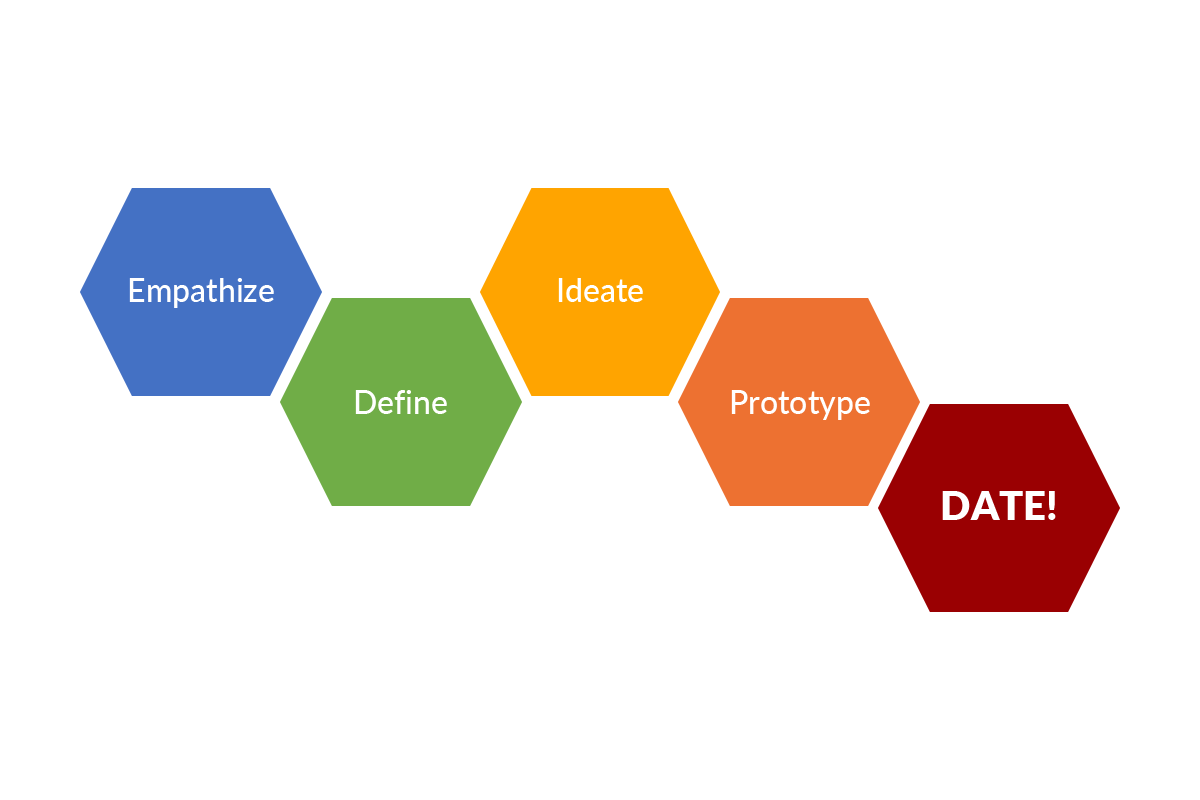
Design Thinking is an iterative process in which we designers seek to gain empathy for the people we’re designing for, challenge our own assumptions, and redefine problems in an attempt to identify alternative approaches and solutions that might not be instantly apparent.
Design Thinking is useful because it helps us re-frame our approach by putting human beings and their wants and needs at the center of the process. It helps us come up with new ideas when we brainstorm and allows us to adopt a hands-on approach in prototyping and testing.
I like Everything is Alive because it’s funny, informative, and entertaining. I love it because it helps me think differently and because of the odd, radical empathy it inspires. Yay! Empathy!

Design Thinking for Dating
I’m prototyping a workshop to help people learn to apply a design thinking approach to dating. An approach that isn’t about manipulation, lying, or entitlement, which seems to be at the heart of so much of the traditional advice, courses, and approaches that are out there. The idea behind Design Thinking for Dating is to approach the whole dating process from a different perspective. The perspective of empathy. The shorthand is this: Stop trying to get the person you think you want to like you. Make it easier for the right person to find you.
Just published on Medium—Design Thinking for Dating.
I’m prototyping a workshop to help people learn to apply a design thinking approach to dating. An approach that isn’t about manipulation, lying, or entitlement, which seems to be at the heart of so much of the traditional advice, courses, and approaches that are out there. The idea behind Design Thinking for Dating is to approach the whole dating process from a different perspective. The perspective of empathy. The shorthand is this: Stop trying to get the person you think you want to like you. Make it easier for the right person to find you.

Corporate therapy FTW
You spend almost every day together—hours and hours of it. You argue, debate, get excited, bounce things off each other, and plan for the future. You email, text, talk on the phone, and in person. It’s one of the most intimate relationships you can have. I’m not talking about your significant other, boyfriend, girlfriend, neutralfriend, or spouse. I’m talking about your business partner.

You spend almost every day together—hours and hours of it. You argue, debate, get excited, bounce things off each other, and plan for the future. You email, text, talk on the phone, and in person. It’s one of the most intimate relationships you can have. I’m not talking about your significant other, boyfriend, girlfriend, neutralfriend, or spouse. I’m talking about your business partner.
Being partners in a business can be fulfilling, exciting, joyous, and fun, but it can also be one of the most stressful experiences you can have. Our business partners get to see us at our best and our absolute worst. Disagreements can turn into hurt feelings, fights, or worse.
You know all those stories about great bands that split up right before (or after) they went big, right? It’s not just a cliche. Being up in each other’s intimate personal space while trying to co-create something that you are all incredibly invested in, at the same time feeling like your very future is on the line? That’s a recipe for fights, frustration, and disaster. Unspoken mini resentments turn into frustrations turn into unspoken big resentments turn into blowups/explosions/lawsuits turn into stories of your failed startup, or relationship.
So what do you do?
In my decades of working on projects for companies of all sizes there’s been one unspoken aspect that’s been consistent across all of them—we members of agency design teams end up feeling like therapists. For a project to be successful it has to be built. For it to be built you have to get to some kind of consensus around decisions. All the decisions. Who you’re building for. What you’re trying to accomplish. What color blue that button should be. etc. And that’s not always easy. Especially when you there’s a room full of people with little resentments.
The best design teams are experts at moderating discussions and mediating disagreements. They help their clients make decisions. Often they have to act like couples councilors just to keep things moving. I often find myself in that role. Holding space for disagreements. Helping team members listen to each other. And providing techniques for decision making that don’t trigger resentment. And I often think, “What happens when I leave? Will these guys just go back to sniping at each other?”
Why wait for a design project to get your team back to happy? Or at least back to listening and respecting each other? Why not implement a little corporate therapy right now? Some simple techniques can help you and your team communicate more clearly, process and release resentments, and get back to having fun creating something magical together.
Corporate therapy? It’s about time.

What a delightful conspiracy
For those that don’t know, DEN (Denver Airport) has been the target of some pretty dark conspiracy theories—everything from being the Illuminati headquarters to the home of an underground bunker complex. DEN just leaned into that something fierce, and I think it’s delightful.

For those that don’t know, DEN (Denver Airport) has been the target of some pretty dark conspiracy theories—everything from being the Illuminati headquarters to the home of an underground Nazi bunker. DEN just leaned into that something fierce, and I think it’s delightful.
Brand can be a tricky thing. Your brand isn’t what you say about yourself, it’s what they say about you—A brand is a person’s gut feeling about a product, service or company. Changing the way people think and feel about you is not an easy task. Especially if those feelings are conspiratorial. People love conspiracy theories, partially because our brains are built to find pleasure in them. So what do you do?
Most organizations would probably just choose to ignore the problem away, but DEN found a delightfully different approach. Embrace the conspiracy! Lean in! Laugh! And make a bunch of people smile in the process. Not an easy thing to do when those people are traveling through an airport.
DEN pulled it off with the Denver Gargoyle, a talking animatronic gargoyle that pokes fun at the Denver Airport conspiracy theories all the while connecting with grumpy, road weary travelers. A little laughter goes a long way.
The most successful organizations don’t just have personality—they have passions and beliefs that stem from an emotional and philosophical core. They care about things. They care about people. When an organization’s core beliefs and identity are clearly expressed, the organization inspires loyalty and excitement. It opens up space for intimacy and relationships. By helping travelers smile in the midst of their travel stress, DEN shows that it cares about the people it serves. It gives them a laugh when they need it most. And it opens up space for connection and delight.
When people feel that they know who an organization is—not just its personality, but its core beliefs and passions—people care about what that organization says and does. They buy the organizations products and services, listen what it says, and they have opinions about everything the organization does. People connect. They care. They might even change their opinions about a long held conspiracy theory.
DEN just went a long way towards helping people make a happy connection with an airport. And I find that delightful.