
Ambient InformationWhat if a system's health could be felt before it fails? A self-initiated experiment in using color, motion and sound to give operators hours of warning, not seconds.
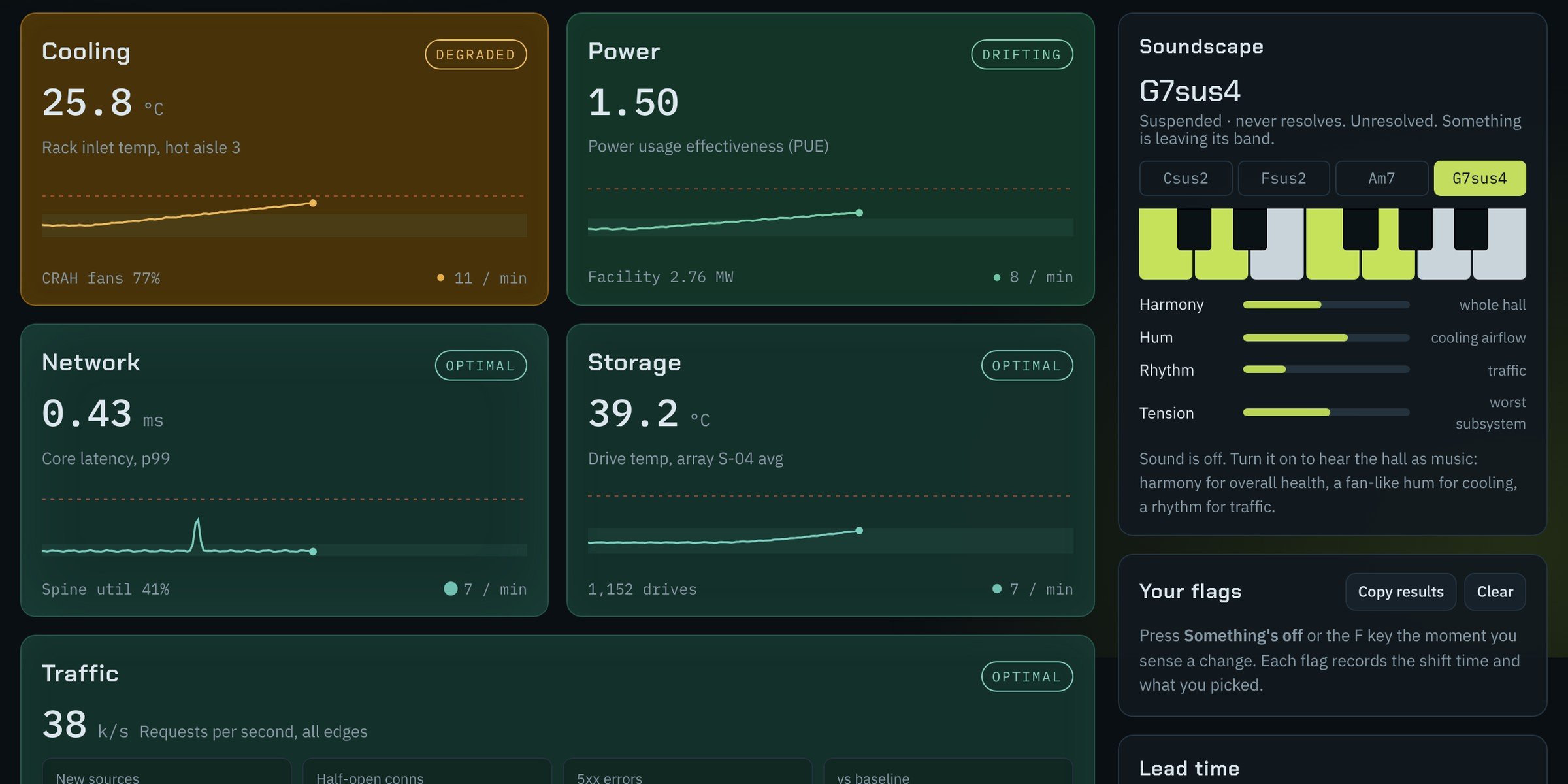
At a glanceI prototyped Undertone, a monitoring interface that expresses a data center’s health through color, motion and music instead of relying on alarms alone. In two simulated scenarios, a failing chiller and a cyberattack, its cues shifted more than an hour before the conventional alarm fired.
The problem
Monitoring tools have two volumes: silence, then a siren.
Everything between "fine" and "broken" lives in charts that someone has to be watching at the right moment. Then a fixed threshold trips and the system jumps straight to an alarm. People get no sense of which way things are heading, so the alarm is almost always a surprise.
Because thresholds are set to catch everything, they also fire too often, and people learn to tune them out. Hospitals call this alarm fatigue: reviews put the share of clinical alarms that are false or need no action between 72% and 99%. Data centers, power grids, water systems and on-call engineering teams live with their own versions of the same problem.
The Idea
Ambient information puts a system's health into the environment of an interface, so people feel a trend long before a threshold trips.
People already sense a lot without trying. We notice a room getting darker, a song turning minor, someone breathing faster across a table. Ambient information borrows those channels:
Color. Each component, and the space around it, tints from cool blue-green toward amber and orange as its health slips. A glance from across the room is enough.
Motion. Each component breathes with a slow pulse that quickens under stress, which peripheral vision picks up well.
Sound. A quiet musical bed plays underneath. Healthy systems sound resolved and warm; as things degrade, the harmony stops resolving, turns minor, then dissonant.
It doesn't replace alarms. It makes sure the alarm is never the first sign of trouble. The idea builds on Mark Weiser and John Seely Brown's "calm technology" and on earlier sonification work like Peep, which turned network events into a soundscape.
Choosing where to start
The obvious place for this idea is the hospital room, where several devices compete for one nurse's attention. But that's the highest-stakes setting there is, and the wrong place to test an unproven idea.
My friend and former co-worker Matthew Coble suggested data centers instead, and the more I looked, the better they fit:
Failures build slowly. A failing chiller or a slowly building cyberattack plays out over minutes to hours, which is exactly the window where ambient cues can help.
Attention is split. Operators work long shifts while juggling tickets, chat and several dashboards.
It's safe to simulate. Realistic telemetry can be generated without putting anyone at risk.
The hospital remains the second phase, once the cues have been proven somewhere lower-stakes.
Designing the signals
Every part of the system gets a health score from 0 to 100, and that one score drives color, motion and sound, so the three channels always agree. Four states, each shown in at least two channels and never in color alone:
Optimal: cool blue-green, slow breathing, a warm major progression
Drifting: warming toward amber, faster breathing, suspended chords that never resolve
Degraded: amber to orange, quicker pulse, a minor progression
Critical: red-orange, the conventional alarm takes over, dissonant chords over a low drone
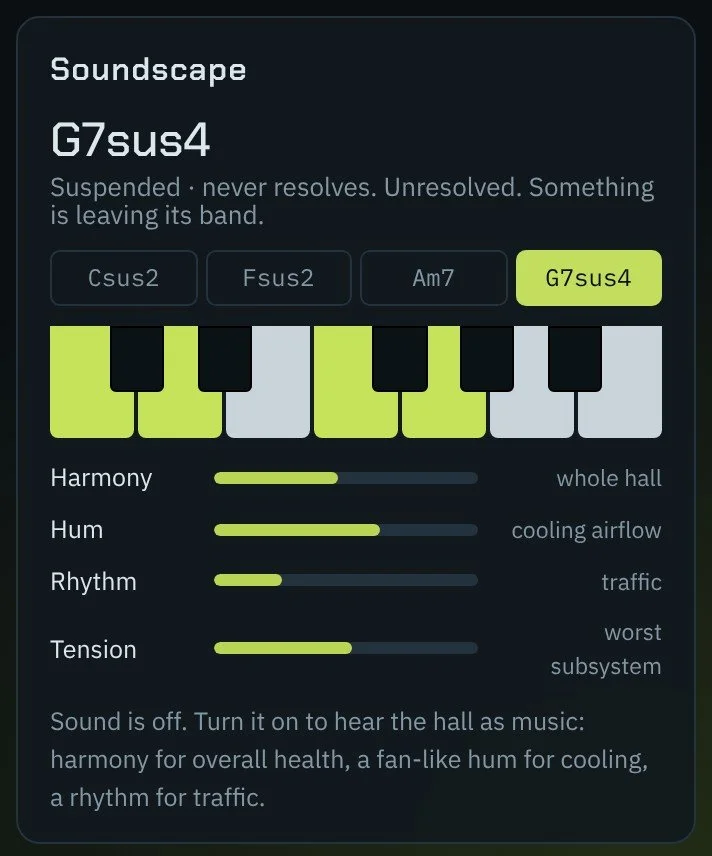
The sound took the most design work. Instead of one tone, the prototype plays a small ensemble, and each instrument stands for a different part of the system. A trained ear can hear not only that something is off, but roughly where.
Harmony follows the health of the whole hall.
A fan-like hum follows the cooling system, rising and brightening as the fans work harder.
A soft ticking rhythm follows network traffic.
A melody follows whichever part is worst, picking up wrong notes as it degrades.
Chords change on the bar line, so a change in state sounds like the music moving on rather than a switch being flipped.
Scenario 1: a chiller fails slowly
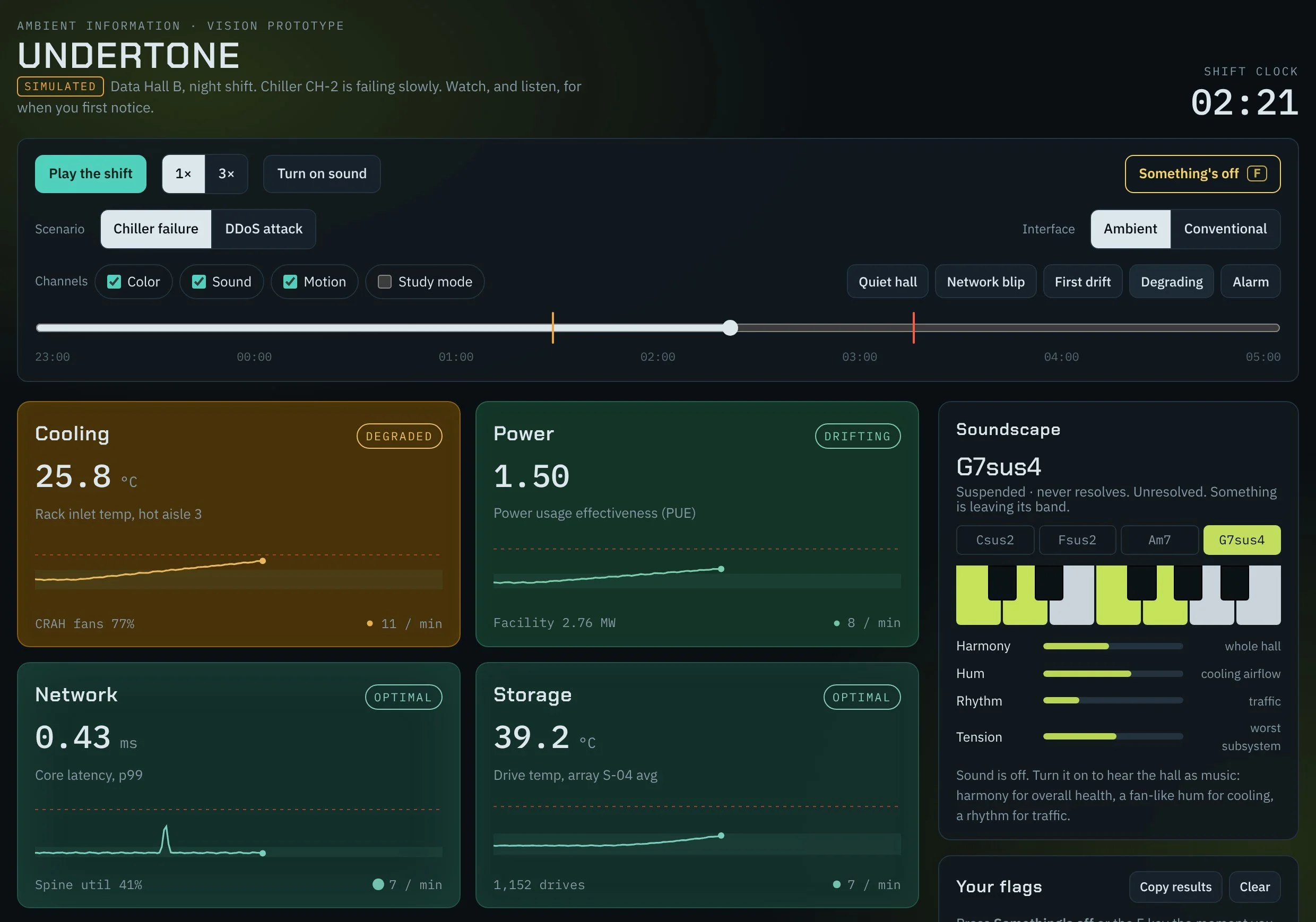
The prototype, called Undertone, shows one data hall (cooling, power, network, storage and traffic) through a six-hour night shift compressed into two and a half minutes. In the first scenario, a chiller loses capacity at a slow, steady rate, and rack temperatures creep up for hours.
The cooling panel and the space around it start warming in color, and the music loses its resolution, at 01:30. The conventional temperature alarm fires at 03:14.
Result: 1 hour 44 minutes of warning an operator wouldn't otherwise get (simulated).
A brief network latency spike is built in on purpose. It ripples through the ambient layer and fades without raising an alarm, showing the difference between a blip and a trend.
Scenario 2: the traffic turns hostile
The chiller is a physical failure. I wanted to know whether the same approach works when the building is fine and the problem is the traffic itself, so the second scenario is a denial-of-service attack. A botnet probes the network edge in short pulses, then sends a slow flood that imitates real users, then turns into a full flood.
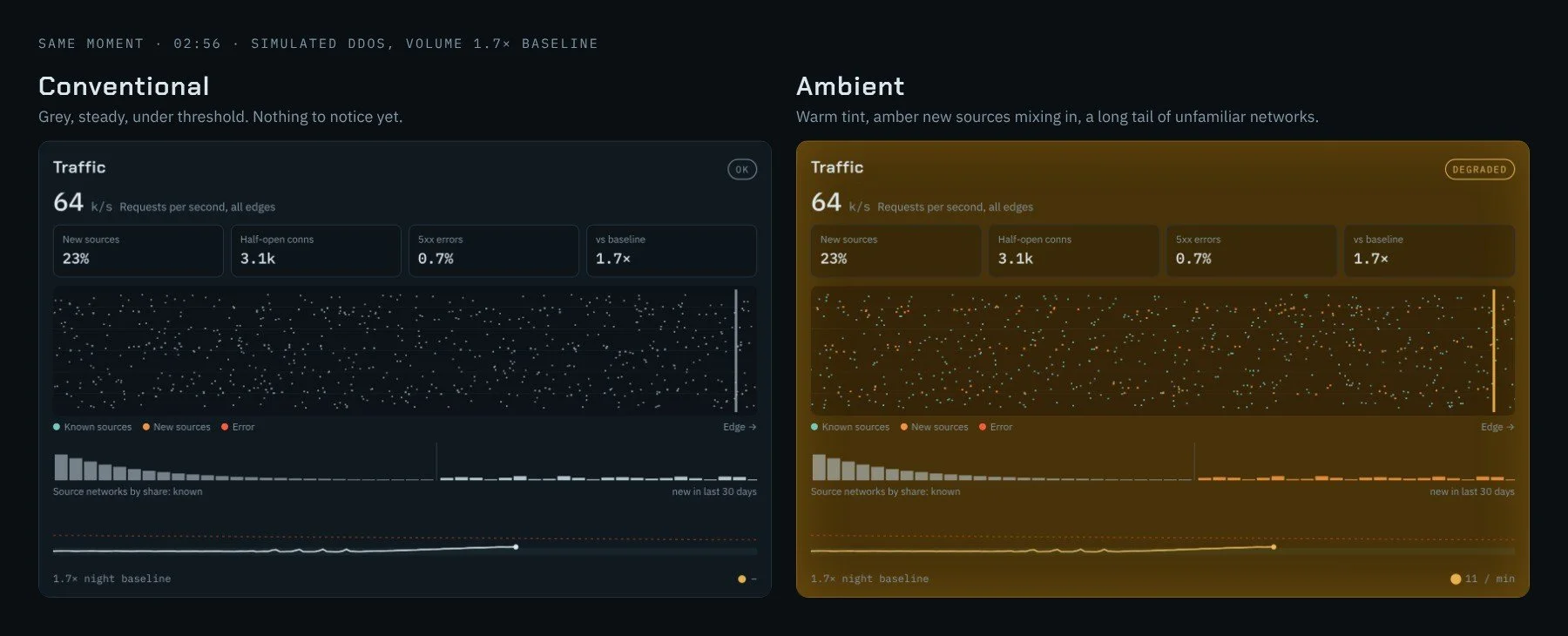
The hard part is that volume is a weak signal. Night traffic varies, and a well-run attack hides inside normal levels until it's too late. So Undertone reads the texture of traffic instead of only its size, blending four signals into the same health score as the physical systems.
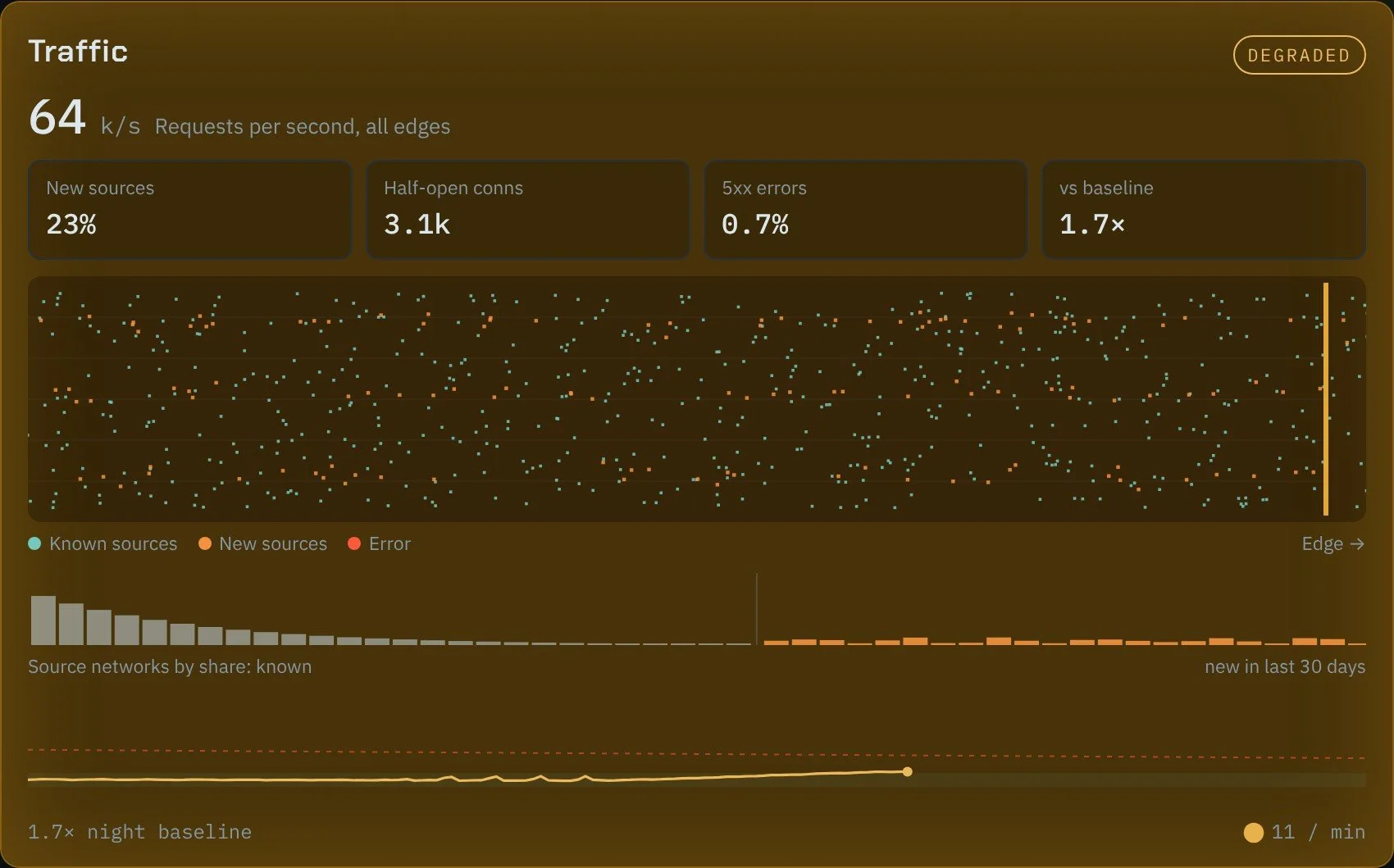
New sources: the share of requests from networks not seen in the last 30 days
Volume against that night's normal, not a fixed number
Half-open connections, a sign the connection queue is backing up
Error rate at the edge
The panel turns those signals into pictures. In the request flow, each dot is a slice of requests moving toward the edge; known visitors are scattered teal, new sources are amber, and organized attack traffic falls into tight lanes and piles up at the edge. The source fingerprint shows which networks requests come from; an attack grows a long, even shelf of unfamiliar networks, each sending a little. In sound, traffic is the ticking voice, and its steady groove breaks into scattered bursts.
The probes show up as brief ripples more than two hours before the alarm. The traffic shifts for good at 02:09, while volume is only 1.3 times normal and well under any threshold. The conventional alarm fires at 03:16.
The result
More than an hour of warning on an attack that volume alone wouldn't catch
Try it: Spooky Action